
NOTE: this was previously called HECS (Higher Education Contribution Scheme).
Following the March inflation data, Australian students who still have HELP/HECS debt, will be hit with a major increase come 1 June 2023.
Whilst interest is not charged on HELP/HECS loans, the amount of the debt is adjusted on the 1st of June each year, in accordance with an annually determined inflation factor. It is based on the year-on-year CPI figure, measured quarterly up to the end of March.
Therefore, the rate of indexation for 2023 will be 7.1%. This is the highest indexation rate seen in 32 years.
Key points
HELP/HECS debt to be indexed at 7.1% from 1 June 2023, following recent inflation data.
- Those looking to avoid indexation will need to BPAY the Australian Tax Office their entire debt before 1 June 2023.
- For Australian students with an average debt of around $22,636, approximately $1,600 will be added to their loan. Those with a $30,000 debt will see $2,130 added to their loan, while a $40,000 loan would see $2,840 added.
Indexation on student debt has spiked over the past three years, starting at 0.6% in 2021 and then increasing to 3.9% in 2022 and 7.1% now (1 June 2023).
Student debts start to be paid off – through tax returns – once annual income hits $48,361, at 1 per cent of income. The repayment percentage increases with higher bands of income, as per the table below:
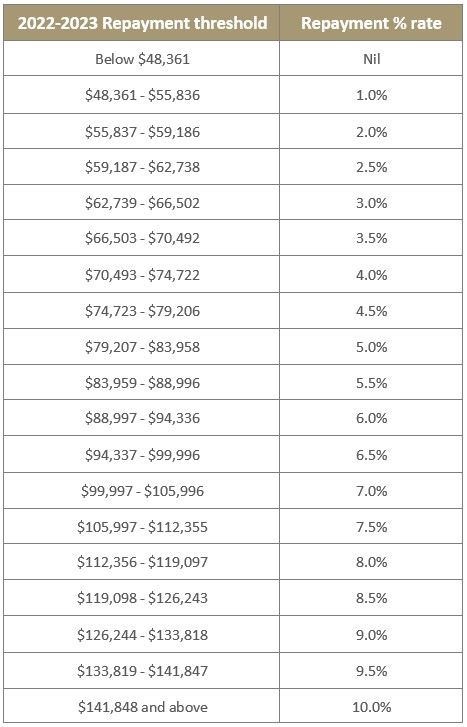
Source: Loan repayment | StudyAssist
Around 15 per cent of Australians (3 million people) – are paying back their student loans, according to the Australia Tax Office (ATO), which estimates that 11 per cent of those owe between $5,000 and $40,000 and 3 per cent owe between $40,000 and $100,000.